Replace Worn Outlets and Add GFCI Protection Safely
Outlets that won't grip a plug are worn out, and any outlet near water should be a GFCI. Both swaps are the same 30-minute job — done with the breaker off and tested twice.
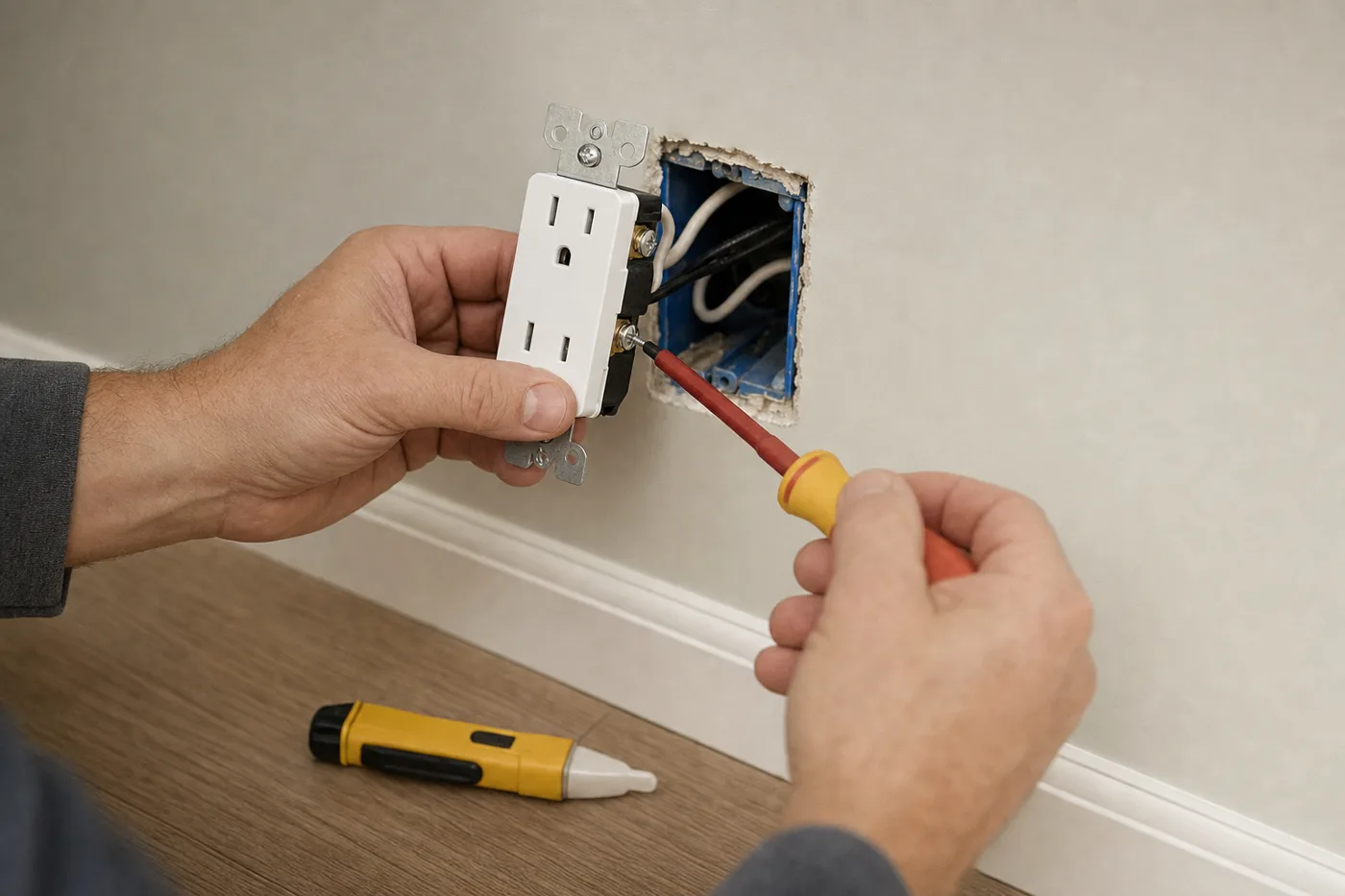
Receptacles wear out like door hinges: after a few thousand plug cycles the internal contacts loosen, plugs sag, and connections start to heat. Meanwhile, code has spent decades expanding where ground-fault protection belongs — kitchens, bathrooms, garages, laundry, outdoors, basements — because a GFCI trips in a fraction of a second when current leaks somewhere it shouldn’t, like through a person. Swapping a worn outlet and installing a GFCI are the same fundamental job, and both are within reach if you follow the safety sequence without shortcuts.
The sequence is the safety
Turn off the breaker, then prove the power is off — plug a lamp or tester into the outlet before you unscrew anything, and touch a non-contact tester to every wire once the cover is off. Breakers get mislabeled; some boxes carry two circuits. Test twice, every time, even when you’re sure.
Photograph before you disconnect
With the outlet pulled from the box, take a clear photo of every wire and its screw. Note how many cables enter the box: one cable means this is the end of the run; two or more means power passes through to other outlets — and that distinction decides how you wire a GFCI.
Understand line versus load
Every GFCI has two pairs of terminals. LINE takes the incoming power — the hot and neutral from the panel. LOAD feeds everything downstream, and whatever connects there inherits GFCI protection. Wire the incoming cable to LOAD by mistake and the outlet either won’t reset or won’t protect. The load terminals ship behind yellow tape for a reason: don’t peel it until you’ve identified the incoming cable.
Make connections that stay tight
Strip to the gauge on the device’s strip guide, hook the wire clockwise around the screw or use the clamp-style back terminals, and torque firmly. Never use spring-only backstab holes — they’re the number one source of the loose, arcing connections you’re here to eliminate. Fold the wires accordion-style and seat the device without straining the terminals.
Test with the buttons and the plug-in tester
Restore the breaker, press RESET, and confirm power. Press TEST — power should drop instantly at this outlet and everything wired to LOAD. Then verify with a plug-in GFCI tester, which also catches reversed hot/neutral and open grounds. Label downstream outlets with the ‘GFCI Protected’ stickers from the box.
Two-wire boxes with no ground can legally take a GFCI — it protects people without a ground wire — but must wear the ‘No Equipment Ground’ sticker. Aluminum wiring, scorched insulation, crowded multi-circuit boxes, or anything you can’t confidently identify: stop and call a licensed electrician. That’s not failure; that’s the system working.
Test twice with the breaker off. The outlet doesn’t know how sure you were.
Press the button monthly
GFCIs are mechanical devices that wear out — press TEST and RESET monthly, and replace any unit that won’t trip or won’t hold. While you’re at it, replace outlets that drop plugs anywhere in the house; a $3 receptacle is the cheapest fire prevention you can buy.
Keep the momentum going
All articles
Install a Smart Thermostat Without Frying Your HVAC Board
A safe smart thermostat installation walkthrough: killing power, photographing and labeling wires, handling the C-wire question, and commissioning without HVAC damage.
Fix a Running Toilet for Good in One Hour
A step-by-step guide to diagnosing and fixing a running toilet: dye-testing the flapper, replacing the fill valve, and knowing when the flush valve seat is the culprit.

How to Paint Kitchen Cabinets Like a Pro
A step-by-step DIY guide to painting kitchen cabinets: degreasing, sanding, priming, and roller technique for a factory-smooth finish on a weekend budget.